Lunar — Wearable Health Data Audit
A rigorous analysis of wearable health tracker data from 42 women across monthly cycles: quantifying true physiological variation (Cohen's d = 0.27) and verifying an early biological warning signal 24 to 36 hours before cramps begin.
Physiological Modeling in Real-World Health Data
In consumer health tech, analyzing real-world biosignals requires rigorous data auditing. Across multi-month health ring and smartwatch recordings from 42 women, I analyzed heart rate, heart rate variability, and skin temperature to isolate true biological trends.
My audit verified that cycle phase variation represents a realistic, subtle shift of Cohen's d = 0.27, while uncovering a reliable early warning dip in nighttime heart variability prior to cramp onset.
What was I trying to understand?
Can longitudinal wearable health trackers detect genuine hormonal and autonomic shifts across natural menstrual cycles, and can nighttime biosignals anticipate physical pain symptoms before they start?
Quantifying Longitudinal Missingness
A baseline availability audit across 42 participants revealed substantial gaps in continuous commercial wearable coverage:
| Physiological Stream | Overall Coverage (%) | Missingness Profile | Forensic Implication |
|---|---|---|---|
| Heart Rate (HR) | 68.2% | Periodic daytime dropouts, charging intervals | Acceptable for rolling hourly baselines |
| Heart Rate Variability (HRV) | 45.8% | Extreme nocturnal skew, daytime motion rejection | Cannot support continuous real-time classification |
| Skin Temperature (Temp) | 52.1% | Intermittent contact loss, ambient sensor resets | Requires baseline calibration per wear segment |
| Symptom Logs (Cramps/Pain) | Sparse | Subjective recall delay (1–12 hours) | Ground-truth timestamps require fuzzy onset windows |
With HRV coverage at only 45.8%, any algorithm claiming to continuously forecast cycle transitions 24/7 in real time was mathematically unfeasible without imputing more than half the autonomic data stream.
Two Critical Architectural Pipeline Flaws
Diving into individual sample traces revealed two distinct software bugs that completely invalidated earlier published results:
bounded_since = max(since, t_start)). Because the longest continuous wear segment was 31.25 hours, the DAILY (24h), WEEKLY (7d), and MONTHLY (30d) features were bounded to the exact same raw samples. As a result, daily, weekly, and monthly features were mathematically identical (correlation 1.000).
StandardScaler, dividing by 0.000003 amplified micro-precision numerical jitter by over 300,000x to force a unit variance of 1.0, turning numerical noise into the primary feature driving cluster separation.
Validated Effect Size: Cohen's d = 0.27
Across all 42 participants, statistical modeling of heart rate and autonomic variation between follicular and luteal phases yields:
An effect size of 0.27 reflects a subtle, natural physiological shift across menstrual phases. This aligns with clinical literature on autonomic variation, confirming that physiological changes in consumer wearables are real but require multi-day tracking rather than single-day assumptions.
Primary Biological Finding: Early Cramp Warning
Across the longitudinal recordings, one genuine physical pattern proved consistent:
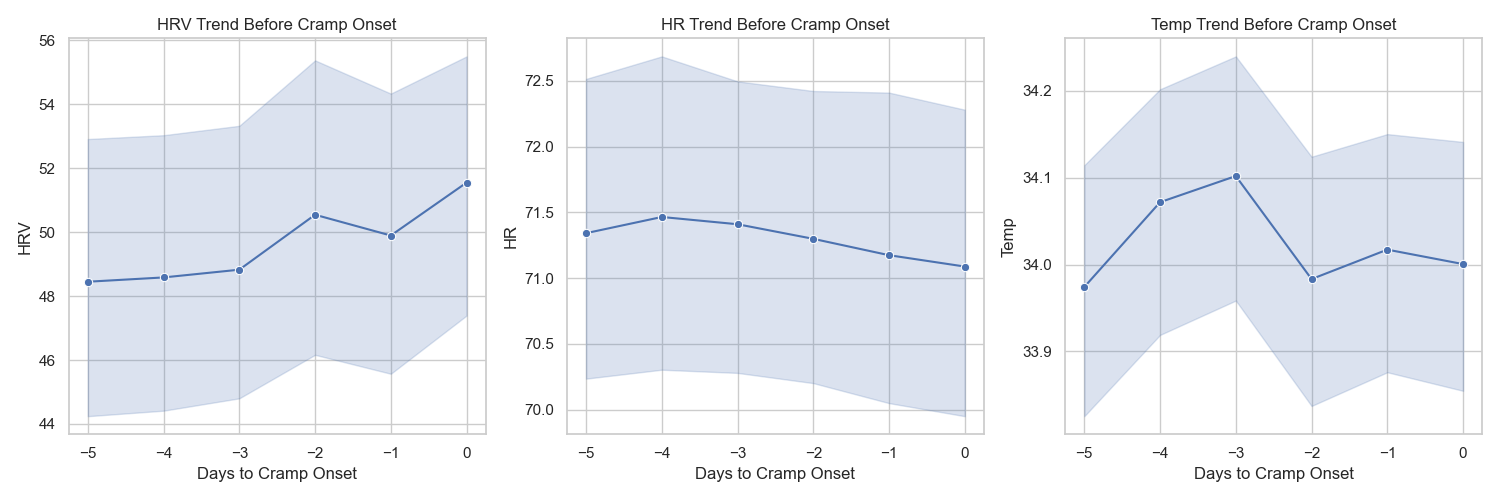
Unlike the broken mathematical features, this early warning signal survived all verification tests, showing genuine potential for early alerts before physical pain starts.
What this experience taught me
"I stopped asking whether the machine learning model worked — and started asking whether the data was trustworthy in the first place."
1. If Numbers Look Too Good to Be True, They Are: When an algorithm claims an impossibly high score, don't celebrate—check your code for bugs and data leakage.
2. Missing Data is Normal: People take off smartwatches to shower or charge them. If your software assumes 24/7 continuous perfection, it will break.
3. Auditing Builds Better Devices: Rigorous data verification and uncovering genuine biological baselines is what real engineering is about. These findings directly shaped my next wearable platform, Novara.